Table of Contents
Most “email automation sequences” are just scheduled blasts with a delay timer. Email 1 goes out day 1. Email 2 goes out day 3. Email 3 goes out day 7. Nobody reads them. Nobody books a call. And the business owner concludes that email automation doesn’t work.
It’s not automation that doesn’t work. It’s static drip sequences. Here’s how to build one that actually converts.
This is part of the AI-Powered Lead Generation: How We Use Automation to Scale Outreach → series.
The Difference Between a Drip Sequence and a Converting Sequence
A drip sequence is time-based. It doesn’t care what the lead does — it just fires on a schedule. A converting sequence is behavior-based. It watches what the lead does — opens, clicks, replies, page visits — and adjusts what they receive next.
That distinction is everything. A lead who opens every email and visits your pricing page twice is not the same as a lead who opened once and went cold. Your sequence should treat them differently — and automatically.
The 5-Email Foundation Sequence
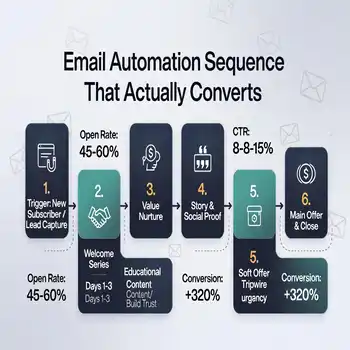
Every converting sequence starts with these five emails. Build this first before adding branches.
Email 1 — Deliver and Set Expectations (Send immediately)
Deliver whatever you promised (lead magnet, audit, guide). Set expectations for what’s coming next. Keep it short. No pitch.
Subject line formula: “Here’s your [thing] + one thing to do first”
Email 2 — The Problem Framing (Day 2)
Name the problem your prospect is experiencing. Be specific. Don’t solve it yet — just demonstrate that you understand their situation better than they do. This is what builds trust.
Subject line formula: “The real reason [common symptom] keeps happening”
Email 3 — The Mechanism (Day 4)
Introduce your approach to solving the problem. Not a pitch — a framework. “Here’s how we think about this. Here’s the system.” Position your method as different from what they’ve tried before.
Email 4 — Proof (Day 7)
A case study, client result, or specific before/after. Real numbers. Short format. End with a soft CTA — “If this sounds like your situation, here’s how we work together.”
Email 5 — Direct Ask (Day 10)
The close. One ask. One link. “Book a 30-minute call.” No hedge, no 3 options, no “feel free to reach out whenever.” Direct.
Adding Behavior Branches
Once the 5-email foundation runs, add these two branches:
Hot lead branch: If a contact opens 3+ emails AND clicks any link → move them to a priority sequence that skips to the direct ask faster. Hot leads don’t need 10 days of nurturing.
Cold lead branch: If a contact doesn’t open emails 2 and 3 → send a re-engagement email with a different subject line and angle before continuing the sequence. If they still don’t open, pause and let them age before a reactivation attempt.
In Brevo: set these as automation triggers on contact behavior. FluentCRM has the same capability under automation workflows. For a deeper breakdown of how these tools connect to a complete lead generation system, read Lead Generation in 2026 →
Subject Lines That Get Opens
Forget formulas that sound like marketing. The subject lines that consistently get the highest open rates for SMB audiences are:
- Questions: “Is this why your leads aren’t converting?”
- Specificity: “The 3-email sequence that booked 14 calls in 30 days”
- Direct: “Quick question about [their business/situation]”
- Pattern interrupt: “Don’t open this if you’re happy with your current close rate”
Test two subject lines per email. Double down on what opens. Kill what doesn’t.
What to Measure
- Open rate target: 35%+ (below 25% = subject line or list quality problem)
- Click rate target: 5%+ (below 2% = email content or CTA problem)
- Reply rate: any reply is a signal — route replies to personal follow-up immediately
- Sequence completion rate: how many leads reach email 5
- Conversion rate: sequence completions → booked calls
The Bottom Line
A converting email sequence is not a newsletter. It’s a sales system. Build it once, optimize it quarterly, and let it run. The difference between a business with a sequence and one without is compounding over time — every lead that enters the system gets worked automatically, whether you’re at your desk or not.
Ready to build yours? Book a free Automation Audit →
Frequently Asked Questions — Email Automation Sequences
How many emails should be in an automation sequence?
A minimum viable sequence is 5 emails over 10 days. That’s enough to establish trust, demonstrate expertise, provide proof, and make a direct ask. Beyond 5, add emails only when you have behavior branches that justify them — a hot lead re-engagement path, a cold lead reactivation, or a post-call follow-up sequence. More emails without behavioral logic is just more noise.
What’s the difference between email automation and email marketing?
Email marketing is broadcast — one message sent to a list at a scheduled time. Email automation is triggered — messages sent based on what a specific contact does or doesn’t do. Email marketing tells everyone the same thing. Email automation responds to individual behavior. For lead generation and conversion, automation outperforms broadcast every time because it delivers the right message at the right moment for each contact’s stage in the decision process.
What tools does Innovex use to build email automation sequences?
For client campaigns, Innovex uses Brevo for its automation workflow capabilities, contact behavior triggers, and deliverability infrastructure. For internal lead generation, we run FluentCRM integrated with WordPress — which keeps contact data, form submissions, and automation workflows inside the same system as the site. The tool matters less than the logic: behavior-based triggers, branching paths, and conversion-focused copy are what drive results regardless of platform.
How do I know if my email sequence is working?
Three numbers tell you everything: open rate (is the subject line working), click rate (is the content compelling enough to act on), and sequence-to-call conversion rate (is the sequence closing leads into booked appointments). Open rate below 25% is a subject line problem. Click rate below 2% is a content or CTA problem. Low conversion despite good opens and clicks is a sequence logic problem — usually the ask comes too late or there’s no clear path to booking.
Should I use the same email sequence for all my leads?
No. Different lead sources and different service interests warrant different sequences. A lead who downloaded a “how to generate leads” guide is not in the same mindset as a lead who requested a website audit. Segmenting by lead source and intent — and routing each segment into a sequence tailored to their specific problem — is what separates a 40% open rate from a 20% one. Start with one sequence, prove it works, then build variants for your top two or three lead sources.