Table of Contents
Most small business owners are their own marketing department. They write the emails, update the website, chase the leads, adjust the ads, and then wonder why they’re exhausted and the pipeline is inconsistent. And no AI Marketing Automation for small business.
The problem isn’t effort. It’s architecture. Manual marketing doesn’t scale — and AI marketing automation fixes that.
This guide covers the complete AI marketing automation system we build for SMBs at Innovex Ventures: what it is, what it replaces, how it’s built, and what results to expect. Every section links to a deeper dive. Start here, go as deep as you need.

What Is AI Marketing Automation?
AI marketing automation is the use of software, artificial intelligence, and connected systems to execute marketing tasks automatically — without manual input for each action.
It’s not one tool. It’s a stack of connected systems that talk to each other: your lead capture form talks to your CRM, your CRM triggers your email sequence, your email sequence tracks behavior and branches, your campaign platform pulls data from your CRM to optimize targeting. The whole chain runs without you touching it.
What AI adds on top of traditional automation: content generation, behavioral prediction, dynamic personalization, and self-optimizing campaigns. The system doesn’t just execute — it learns and adjusts.
What AI Marketing Automation Replaces
Before building the system, map what you’re replacing. Every one of these is a manual task eating your time:
- Manually tagging and sorting leads in your CRM
- Writing and sending individual follow-up emails
- Checking ad performance and shifting budget manually
- Publishing blog posts and social content on a manual schedule
- Building and sending weekly or monthly email newsletters
- Pulling data from multiple platforms to create a performance report
- Reminding yourself (or your team) to follow up with specific leads
Every item on that list has an automated equivalent. The goal is to replace the list entirely.
The 6 Components of a Complete AI Marketing Automation System
1. Lead Capture & Qualification
The entry point. Every lead that enters your system — form submission, chatbot conversation, landing page conversion, ad click — gets captured, tagged by source and intent, and routed automatically to the right sequence.
A lead from a Google Ads campaign goes into a different sequence than a lead who downloaded your lead magnet organically. Same CRM, different path, different messaging. Zero manual sorting.
Tools: WPForms or Fluent Forms connected to Brevo or FluentCRM. Tag logic built on source UTM parameters and form field values.
2. Email Nurture Sequences
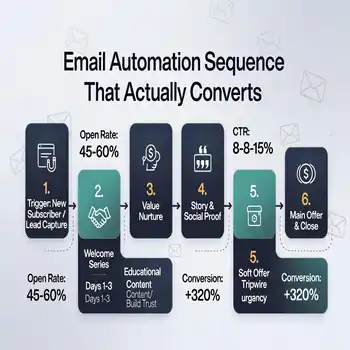
The engine. A behavior-triggered email sequence moves a lead from first contact to booked call — automatically, over days or weeks, without you touching it.
The key word is behavior-triggered. A static drip sequence sends email 1, then email 2, then email 3 regardless of what the lead does. A behavior-triggered sequence branches: if they clicked the pricing link in email 2, they get the pricing-focused email 3. If they didn’t open email 2, they get a re-engagement version first.
AI layer: sequences are written by AI, personalized by field data (name, company, service interest), and refined over time based on open and click data.
Learn more: How to build an email automation sequence that actually converts
3. CRM Automation
Your CRM is the central nervous system. Without automation, it’s a manual data entry project nobody keeps current. With automation, it updates itself.
What automated CRM does: tags contacts on form submission, updates deal stages when emails are opened or links clicked, creates follow-up tasks automatically, routes hot leads to priority sequences, and fires alerts when a lead goes cold.
Your pipeline stays accurate without anyone touching it manually.
Learn more: CRM automation for small business: what to set up first
4. AI Lead Nurturing
Not all leads are ready to buy. Most need nurturing — education, trust-building, repeated exposure to your value proposition before they’re ready to book a call.
AI lead nurturing automates that process. It identifies where a lead is in the buying cycle based on their behavior, delivers the right content at the right time, and surfaces them to your sales process when their behavior signals readiness.
A lead who opens 4 emails in a row and clicks your pricing page twice is different from a lead who opened once and went cold. Your system should treat them differently — and automatically.
Learn more: AI lead nurturing: how to move cold leads to booked calls automatically
5. Campaign Automation
Ad campaigns that don’t connect to your CRM are flying blind. You know who clicked, but not who converted, who became a customer, or what their lifetime value was.
Campaign automation closes that loop. CRM data flows back into your ad platforms — Google Ads and Meta — to build audiences from actual customers, suppress existing clients from prospecting campaigns, and feed conversion data back for algorithmic optimization.
The result: campaigns that get smarter over time using your real customer data, not just platform-level click data.
6. AI Content Delivery
Publishing consistently is one of the highest-ROI marketing activities for SMBs — and one of the first things to stop when you’re busy. AI content automation fixes that.
Using Claude via MCP connected directly to your WordPress site, we build content workflows that generate, review, schedule, and publish blog posts, newsletters, and social content on a consistent cadence — without manual writing or scheduling.
Learn more: AI content automation: how to publish weekly without writing manually
The Stack
We build on tools you can own — no proprietary platforms, no vendor lock-in:
- CRM: Brevo, FluentCRM
- Email: Brevo sequences, FluentSMTP, MailPoet
- Forms: WPForms, Fluent Forms
- AI: Claude via MCP, Easy MCP AI Connector
- Campaigns: Google Ads, Meta with CRM sync
- WordPress: Astra + Gutenberg + Spectra
What This Costs vs. What It Replaces
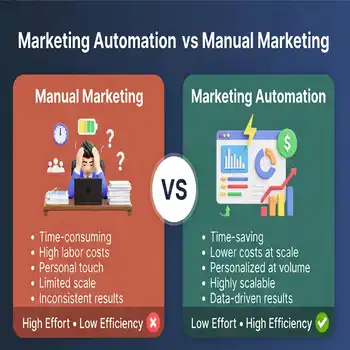
The real question isn’t what automation costs — it’s what manual marketing is already costing you.
If you’re spending 10 hours/week on marketing tasks a system could handle, and your time is worth $100/hour, that’s $1,000/week in opportunity cost. $4,000/month. An automation system at $999/month pays for itself before month 2.
Learn more: Marketing automation vs manual marketing: the real cost comparison
Learn more: How much does marketing automation cost? Real pricing breakdown
Case Study: Med Spa Full-Stack Automation
A med spa client came to us with a working Google Ads campaign generating leads — and a follow-up process that was entirely manual. Leads came in via a contact form, sat in a Gmail inbox, and got followed up with when someone remembered to do it.
We automated the entire post-capture workflow: form submission triggered CRM tagging and immediate email confirmation, a 5-email nurture sequence fired over 10 days, hot leads (3+ email opens, pricing page visit) got flagged for same-day personal outreach, and a weekly report summarized lead volume, sequence performance, and conversion rate.
Result: follow-up time dropped from 4 hours/week to 20 minutes. Lead-to-consultation conversion rate increased 34% within 60 days.
Full case study: How we automated a med spa’s entire follow-up workflow
How to Get Started – AI Marketing Automation for small business
The fastest path is a Free Automation Audit. We map your current marketing workflow, identify every manual step that should be automated, and show you exactly what a system looks like for your business — before you commit to anything.
Book your free 30-minute Automation Audit →
All Posts in This Series
- How to build an email automation sequence that actually converts
- CRM automation for small business: what to set up first
- AI lead nurturing: how to move cold leads to booked calls automatically
- Marketing automation vs manual marketing: the real cost comparison
- How we automated a med spa’s entire follow-up workflow (case study)
- The best marketing automation tools for SMBs in 2026
- How much does marketing automation cost? Real pricing breakdown
- AI content automation: how to publish weekly without writing manually
- Digital Bright Future