Table of Contents
Before you decide whether marketing automation vs manual marketing is it right for your business, run this calculation. Take the number of hours per week your team spends on manual marketing tasks. Multiply by your effective hourly rate. That’s what manual marketing is already costing you — before you factor in the leads you’re losing because follow-ups are slow, inconsistent, or never happen.
This is part of the AI Marketing Automation for SMBs: The Complete System series.
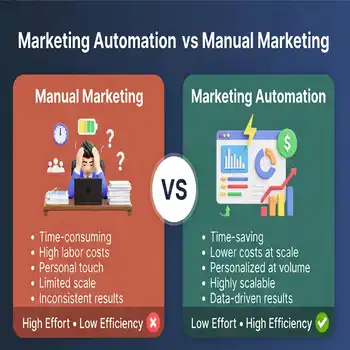
The Real Cost of Manual Marketing
Let’s use a conservative example. A service business owner or marketing manager spending:
- 3 hours/week managing email follow-ups
- 2 hours/week updating CRM records
- 2 hours/week reviewing and adjusting ad campaigns
- 2 hours/week writing or scheduling social/email content
- 1 hour/week pulling performance reports
That’s 10 hours/week. At $75/hour (conservative for an owner or senior employee), that’s $750/week — $3,000/month in labor cost for tasks that could be automated.
And that’s only counting time spent, not leads lost to slow follow-up. Studies consistently show lead conversion rates drop 80% when response time exceeds 5 minutes. If your follow-up is manual, your response time is measured in hours, not minutes.
The Cost of Marketing Automation
A properly built AI marketing automation system for an SMB typically costs:
- Setup: $1,500–$3,000 one-time (workflow build, CRM configuration, sequence writing)
- Monthly retainer: $499–$1,999/month depending on scope
- Tools: $0–$150/month (Brevo free tier covers most SMBs to start)
Total first-year cost at the mid tier: roughly $15,000–$18,000.
Compare that to $36,000/year in manual marketing labor — and a system that converts leads faster, follows up more consistently, and runs at 2am when you’re not working.
What Automation Does That Manual Cannot
Speed: An automated sequence fires within 60 seconds of form submission. Manual follow-up averages 47 minutes in most SMBs (and that’s when someone remembers).
Consistency: Automation doesn’t forget, get sick, go on vacation, or skip a follow-up because it was a busy Tuesday. Every lead gets worked every time.
Scale: Manual marketing has a ceiling — the number of hours in the week. Automated marketing has no ceiling. The same system that works 50 leads/month works 500 leads/month with no additional labor.
Data: Automated systems track every touchpoint. You know exactly which emails were opened, which links were clicked, which pages were visited, and what sequence led to the booking. Manual marketing produces gut feelings, not data. Our Automation Offer->
Where Manual Still Wins
Automation isn’t a replacement for judgment. Manual outperforms automation in:
- Hot lead closing: A lead who replies to an email or requests a callback needs a human immediately, not the next automated email
- High-value relationship building: Enterprise deals, referral partners, strategic accounts — these need personal attention
- Strategy: What to automate, how to sequence it, what content to build — automation executes the strategy, humans build it
The right model: automate everything that doesn’t require judgment. Reserve human attention for everything that does.
The Payback Timeline – Automation for Marketing
For most SMBs, marketing automation pays for itself within 90 days — not from cost savings alone, but from revenue the system captures that manual follow-up was losing. One additional closed deal per month from faster follow-up typically covers the retainer cost entirely.
Want to see what this looks like for your specific situation? Book a free Automation Audit →
FAQ – Marketing Automation vs Manual Marketing
How long does it take for marketing automation to pay for itself?
For most SMBs, marketing automation pays for itself within 90 days. The payback comes from two sources: labor hours recovered (typically 8–12 hours/week for a small team) and revenue captured from faster lead follow-up. One additional closed deal per month from automated follow-up typically covers the entire retainer cost.
What’s the minimum budget needed to start marketing automation?
A functional marketing automation setup for an SMB starts at $499/month for management plus $0–$150/month in tools — Brevo’s free tier covers most businesses up to 1,000 contacts. The one-time setup cost runs $1,500–$3,000. Compare that to $3,000+/month in manual marketing labor and the math is straightforward.
Can small businesses with no CRM use marketing automation?
Yes. Marketing automation setup includes CRM configuration — you don’t need an existing system. Brevo and FluentCRM are both zero-cost starting points that integrate directly with WordPress. The automation builds on top of whatever you already have, or starts from scratch if you have nothing.
What tasks should never be automated?
Hot lead closing, high-value relationship building, and strategic decisions should stay manual. When a lead replies or requests a callback, a human needs to respond immediately — not the next automated email. Automation handles volume and consistency. Human judgment handles conversion and strategy.
How is automation for marketing different from just scheduling emails?
Scheduled emails fire on a timer regardless of what the contact does. Marketing automation responds to behavior — opens, clicks, page visits, form submissions. A lead who visits your pricing page twice gets a different message than one who went cold after email one. Behavior-based automation consistently outperforms scheduled blasts on open rate, click rate, and conversion.
Also AI Blog->