Table of Contents
Most B2B businesses don’t have a lead problem. They have a funnel problem.
They’re generating traffic. They’re running ads. They’re posting content. But somewhere between “prospect sees your brand” and “prospect books a call,” the pipeline leaks — and revenue disappears with it.
This post breaks down exactly how a B2B lead generation funnel works, where most funnels fail, and how to build one that converts. Every stage here connects back to the full system we outlined in The Complete B2B Lead Generation System for SMBs in 2026.
What a B2B Lead Generation Funnel Actually Is
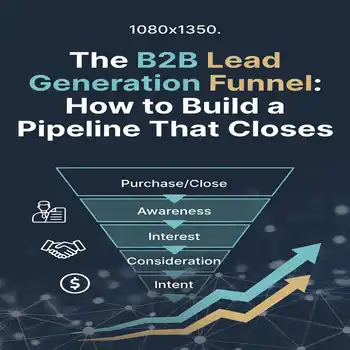
A funnel is not a metaphor. It’s a structured sequence of stages that moves a cold prospect through awareness, consideration, and decision — until they become a paying client.
The word “funnel” exists because not everyone who enters the top makes it to the bottom. That’s expected. The goal isn’t a 100% conversion rate — it’s a predictable one. When you know exactly how many leads enter each stage and how many exit, you can optimize at every point and forecast revenue with precision.
Most SMBs don’t have a funnel. They have a collection of disconnected tactics — an ad here, a cold email there, a contact form that nobody follows up on. That’s not a funnel. That’s hope.
The Three Stages: TOFU, MOFU, BOFU
TOFU — Top of Funnel (Awareness)
Top-of-funnel is where cold prospects first encounter your brand. They don’t know you yet. They’re not ready to buy. They have a problem and they’re looking for information, not a sales pitch.
Your job at TOFU is one thing: get in front of the right people and earn their attention.
What works at TOFU: SEO content targeting informational and problem-aware keywords, Google Ads on broad problem-aware search terms, LinkedIn content that surfaces in your target buyer’s feed, and cold outreach introducing the problem — not your service.
What kills TOFU: Leading with your service. Cold prospects don’t care about your agency, your process, or your team. They care about their problem. Speak to the problem first — always.
TOFU metric that matters: Qualified traffic — visitors who match your ICP, not just anyone landing on your site.
MOFU — Middle of Funnel (Consideration)
Middle-of-funnel is where prospects move from “I have a problem” to “I’m evaluating solutions.” They know you exist. They’ve read something, clicked something, or seen your name more than once. Now they’re deciding whether you’re worth a deeper look.
This is where most B2B funnels collapse. TOFU gets attention, BOFU closes deals — but MOFU is where trust is built, and most businesses skip it entirely.
What works at MOFU: Lead magnets that deliver real value, email nurture sequences that educate over 30–60 days, case studies with specific before/after numbers, retargeting ads that reinforce your positioning, and LinkedIn thought leadership that shows your thinking — not just your services.
What kills MOFU: Going silent after the first touch. B2B buyers need 6–12 touchpoints before they’re ready to buy. If your follow-up stops after one email, you’re handing deals to competitors who are more persistent.
MOFU metric that matters: Lead-to-MQL rate — how many of your leads are marketing qualified, meaning they match your ICP and have shown intent signals.
BOFU — Bottom of Funnel (Decision)
Bottom-of-funnel is where qualified prospects are ready to make a decision. They’ve done their research. They’re comparing options. Your job at BOFU is to eliminate friction and make the decision easy.
What works at BOFU: A clear low-friction CTA, social proof specific to their industry, a free strategy session that delivers value before money changes hands, objection-handling content, and direct outreach to prospects who’ve shown multiple intent signals.
What kills BOFU: A weak CTA. “Contact Us” is not a call to action. “Get Your Free Lead Generation Audit” is. The specificity of your offer determines whether a warm prospect converts or bounces.
BOFU metric that matters: MQL-to-SQL rate and close rate.
The 5 Stages Inside a High-Converting B2B Funnel
Stage 1 — Attract
Pull the right prospects into your orbit through SEO, paid search, and outbound. Volume without targeting burns budget. Your ICP must be defined before you spend a dollar attracting anyone — industry, company size, revenue range, decision-maker title, and the specific pain point your service solves.
Stage 2 — Capture
Turn anonymous traffic into known leads. A prospect browsing your site is not a lead. Capture mechanisms that work in B2B: high-value lead magnets (an audit, a template, a ROI calculator — not a generic PDF), direct booking pages for prospects ready now, and exit-intent offers for last-chance capture.
The form is never the bottleneck. The offer behind it is. If your lead magnet isn’t valuable enough to trade an email address for, fix the offer — not the form design.
Stage 3 — Nurture
Most B2B leads are not ready to buy when they first convert. A functional nurture sequence:
- Email 1 (Day 0): Deliver the lead magnet. Set expectations.
- Email 2 (Day 2): Address the #1 mistake in your prospect’s situation.
- Email 3 (Day 5): Case study — specific client, specific problem, specific result.
- Email 4 (Day 9): Framework or checklist that solves part of the bigger problem.
- Email 5 (Day 14): Social proof + soft CTA.
- Email 6 (Day 21): Hard CTA — direct offer for a strategy session.
- Emails 7–12 (Days 30–90): Long-tail nurture — monthly value touch to stay top of mind.
Stage 4 — Convert
Conversion lives or dies on two things: the offer and the friction. “Get Your Free Lead Generation Audit” outperforms “Schedule a Call” because it frames the interaction as value delivery, not a sales pitch. Strip the booking form down — name, email, company, one qualifying question. The sales call handles the rest.
Stage 5 — Measure
The six numbers every B2B funnel owner must track: cost per lead by channel, lead-to-MQL rate, MQL-to-SQL rate, close rate, customer acquisition cost, and revenue per lead. These six numbers tell you exactly which stage to fix — so you’re optimizing on data, not guesses.
Where B2B Funnels Leak — And How to Fix It
Leak #1 — Wrong Traffic
Symptom: High traffic, low conversions. Fix: Tighten targeting before increasing spend. Audit your top keywords — are they attracting your actual buyer? Add negative keywords aggressively in Google Ads. Write content for your buyer’s specific problem, not a broad topic.
Leak #2 — Weak Capture
Symptom: Good traffic, low opt-in rate. Fix: The offer is wrong. Replace generic offers with problem-specific ones. Conversion rates on lead magnets should be 15–25% for targeted traffic — below 10% means the offer needs to change.
Leak #3 — No Nurture
Symptom: Leads go cold. Fix: Build the nurture sequence. A prospect who downloads your lead magnet today might not be ready to buy for 60 days. If you’re not in their inbox during that window, your competitor is.
Leak #4 — Friction at Conversion
Symptom: Warm leads visit the booking page and don’t convert. Fix: Count the fields on your form. Count the clicks from a nurture email to a booked call. Every extra step costs conversions. One offer, one CTA, one form — nothing else on the page.
Leak #5 — No Measurement
Symptom: You’re spending money but don’t know which channel produces revenue. Fix: UTM tracking on every campaign, every ad, every email link. Connect GA4 to your booking form. Without this, you’re funding channels that don’t work while starving the ones that do.
Real Funnel Benchmarks for B2B SMBs
| Funnel Stage | Benchmark | Below Average |
|---|---|---|
| Landing page conversion rate | 15–25% | Below 10% |
| Lead-to-MQL rate | 20–30% | Below 15% |
| Email open rate (nurture) | 30–45% | Below 20% |
| MQL-to-SQL rate | 25–40% | Below 15% |
| SQL-to-close rate | 20–35% | Below 15% |
| Cost per lead (Google Ads, B2B) | $30–$80 | Above $150 |
How to Build Your Funnel in 90 Days
Days 1–30: Foundation
- Define your ICP — one buyer, one problem, one outcome
- Build one landing page with one lead magnet offer
- Set up email automation (ActiveCampaign, Klaviyo, or HubSpot)
- Write your 6-email core nurture sequence
- Install GA4 and UTM tracking on all pages
- Launch one traffic channel — Google Ads or SEO, not both simultaneously
Days 31–60: Optimize
- Review landing page conversion rate — below 10%, test a new headline
- Review email open rates — below 25%, test subject lines
- Add a second traffic channel once the first is producing data
- Build retargeting campaigns for visitors who didn’t convert
- Create one case study with real client numbers
Days 61–90: Scale
- Increase budget on channels with confirmed CPL under target
- Extend nurture sequence to 90 days
- Add a second lead magnet targeting a different ICP segment
- Review close rate — below 20%, address sales process or offer structure
- Document every conversion rate, CPL, and close rate — this becomes your Month 4 baseline
The Funnel Is a System — Not a Campaign
A campaign has a start date and an end date. When it stops, leads stop. A funnel runs continuously — attracting prospects while you sleep, capturing leads automatically, nurturing them over weeks without manual intervention, and converting them when they’re ready.
The businesses that win at lead generation aren’t the ones with the biggest budget. They’re the ones with the most systematic, well-measured funnel — because a system compounds over time in a way that campaigns never can.
For the full breakdown of every component — traffic channels, capture mechanisms, automation frameworks, and the complete 90-day build sequence — read The Complete B2B Lead Generation System for SMBs in 2026.
Ready to Build Your B2B Lead Generation Funnel?
Innovex Ventures builds end-to-end B2B lead generation funnels for small and mid-size businesses — strategy, build, and optimization included.
Get Your Free Strategy Session — we’ll audit your current funnel, identify the largest leak, and show you exactly what to fix first.
B2B lead generation funnel:
Any questions for AI role in Lead gen. –>