Most SMBs Don’t Have a Lead Generation Problem. They Have a System Problem.
So you’ve tried Google Ads. You’ve posted on LinkedIn. How many you’ve sent cold emails that went nowhere. You hired an agency that delivered traffic reports full of numbers that never showed up in your bank account.
The problem isn’t effort. The problem is you’re running tactics without a system.
A B2B lead generation system is different from a campaign. A campaign runs for a few weeks, produces some clicks, then stops. A system runs continuously, improves over time, and fills your pipeline with qualified buyers — people who have a problem you solve and the budget to pay for it.
This is the exact lead generation system Innovex Ventures builds for SMBs. Every component. Every channel. Every stage of the funnel. Real numbers from real clients, not hypothetical benchmarks.
By the end of this guide you’ll know exactly what a functional B2B lead generation system looks like, which channels work for SMBs in 2026, how to build a funnel that converts traffic into booked calls, and how to measure everything so you know what’s working before you scale.
This is the hub post for Innovex Ventures’ lead generation content. Every article in this cluster links back here. Read this first, then go deep on the specific channels and tactics that matter most for your business.
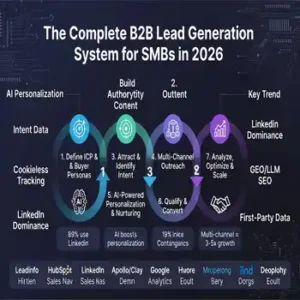
What Is a B2B Lead Generation System?
A B2B lead generation system is a repeatable, measurable process that moves your ideal buyer from first awareness of your business to a booked sales conversation — without requiring you to manually chase every prospect.
It has five components:
- Traffic sources — channels that bring your ideal buyer to you (SEO, Google Ads, outbound email, LinkedIn)
- A lead capture mechanism — a landing page, lead magnet, or contact form that converts visitors into leads
- A qualification process — a way to separate buyers from browsers before they hit your calendar
- A nurture sequence — automated follow-up that keeps warm leads moving toward a decision
- A measurement framework — tracking that shows you cost per lead, lead-to-call rate, and revenue attributed by channel
Most SMBs have one or two of these. The ones generating consistent revenue have all five working together.
The difference between a system and a tactic is compounding. A single Google Ads campaign produces leads while you’re paying for it. A system that combines SEO content with paid retargeting, a high-converting landing page, and an automated follow-up sequence produces leads at decreasing cost over time — because each component makes the others more effective.
The State of B2B Lead Generation in 2026
Here’s what’s different in 2026 versus three years ago even last year— and what it means for your lead generation strategy.
AI Changed Buyer Research Behavior
More than 60% of B2B buyers now use AI tools — ChatGPT, Perplexity, Google SGE — as part of their research process before contacting a vendor. They’re getting answers from AI engines before they ever visit your website. This means if you’re not showing up in AI-generated answers, you’re invisible to a significant portion of your addressable market.
The implication of that is: content quality matters more than ever. AI engines cite sources they trust. To get cited, your content needs to be specific, authoritative, and structured around the exact questions your buyers are asking. Generic blog posts don’t get cited. Detailed, data-backed expert content does.
The Death of Generic Outreach
Cold email response rates collapsed between 2022 and 2025 as inboxes flooded with AI-generated sequences. Buyers now delete generic outreach on sight. What works in 2026 is hyper-personalized outreach targeting a narrow, well-defined segment with a message that demonstrates you’ve done your homework on their specific situation.
Volume-based cold outreach is dead. Intent-based, research-driven outreach is alive and producing strong results for the agencies that have adapted.
Google Ads Got More Expensive and More Powerful
Average cost-per-click for B2B keywords increased across most industries. But AI-powered campaign optimization — smart bidding, Performance Max, automated audience targeting — has simultaneously improved conversion rates for well-structured campaigns. The agencies losing money on Google Ads are running campaigns built for 2019. The agencies winning are running tightly structured campaigns with conversion-focused landing pages and aggressive negative keyword lists.
The Buying Committee Got Larger
The average B2B buying decision now involves 6–10 stakeholders. A single champion inside your prospect’s organization is rarely enough to close a deal. Your lead generation system needs to account for this — content that speaks to different roles in the buying committee, nurture sequences that keep multiple contacts warm simultaneously, and sales conversations that address concerns from finance, IT, and operations, not just the decision-maker you first reached.
The Innovex Lead Generation System: All 5 Stages
Stage 1: Define Your Ideal Buyer Profile
Everything in your lead generation system depends on this. If you get it wrong, you’ll generate leads that don’t close. If you get it right, every other component of the system becomes easier and cheaper.
Your Ideal Buyer Profile (IBP) is not a demographic description. It’s a specific definition of the buyer who has the most urgent version of the problem you solve, the ability to pay your price, the authority to make a decision, and a track record of becoming long-term clients.
For most SMBs, this means answering five questions:
- What industry are they in? Not “small businesses” — be specific. Roofing contractors in the southeast. Insurance brokers with 5–20 producers. Medical spas with two or more locations.
- What is their revenue range? This determines their ability to pay and their sophistication as buyers.
- What is the specific trigger event that makes them start looking for a solution like yours? New regulations. A competitor taking their leads. A failed campaign. A growth target they can’t hit with their current approach.
- Who makes the decision? Owner, VP of marketing, operations director? Who do you need to reach?
- What does failure look like for them if they don’t solve this problem? This is the emotional driver behind the purchase decision.
At Innovex Ventures, we run an IBP workshop with every new client before touching a single campaign setting. The sessions that skip this step produce leads that don’t close. The sessions that do this work properly produce pipelines that convert.
Stage 2: Build Your Traffic Infrastructure
Traffic is the fuel for your lead generation system. Without consistent, qualified traffic hitting your lead capture mechanism, nothing else matters. There are four traffic channels that work for B2B SMBs in 2026. Most businesses should run two or three simultaneously.
Channel 1: Buyer-Intent SEO
SEO for lead generation is different from SEO for traffic. You’re not chasing search volume — you’re chasing buyer intent. A keyword with 200 monthly searches from people who are actively evaluating vendors is worth ten times more than a keyword with 10,000 searches from people just learning about a topic.
Buyer-intent keywords signal purchase readiness. They include terms like “best [service] for [industry],” “[service] pricing,” “[service] vs [competitor],” and “[service] agency near me.” These keywords convert at 3–5x the rate of informational keywords because the people searching them are already in buying mode.
The SEO strategy that drives lead generation for SMBs in 2026 has three components:
- A pillar page targeting a high-intent head keyword (like this one) that establishes topical authority and links to all supporting content
- Cluster posts targeting long-tail buyer-intent queries that feed traffic back to the pillar and to your service pages
- Service pages optimized for local and vertical-specific buyer intent, with direct conversion paths to your lead capture mechanism
Timeline: SEO takes 3–6 months to produce significant organic traffic. It’s not the right channel if you need leads in 30 days. It is the right channel if you want to build a lead generation asset that compounds in value over time and eventually produces qualified leads at near-zero marginal cost.
→ Deep dive: Lead Generation in 2026 — Why Most Businesses Fail
Channel 2: Google Ads
Google Ads is the fastest path to qualified leads for B2B SMBs. When built correctly, a Google Ads campaign can be producing booked calls within 2–3 weeks of launch. The problem is that most SMB Google Ads campaigns are built incorrectly — and the cost of a poorly built campaign is significant.
The Innovex Google Ads framework for lead generation has five non-negotiable components:
- Tight keyword targeting — exact and phrase match only for bottom-of-funnel buyer-intent terms. No broad match. No Performance Max without a large enough conversion dataset to support it.
- Aggressive negative keyword lists — built before launch, not after you’ve burned budget. A typical Innovex campaign launches with 200+ negative keywords.
- Dedicated landing pages — not your homepage. A landing page built specifically for the search intent of each ad group, with a single conversion path and no navigation to distract visitors.
- Conversion tracking — form submissions, phone calls, and booked appointments all tracked at the keyword level so you know exactly which search terms are producing leads and which are burning budget.
- Weekly optimization — search term reports reviewed every week, underperforming keywords paused, bids adjusted based on conversion data, ad copy tested continuously.
A client in the home services space came to Innovex running a Google Ads campaign that had been live for eight months producing 3 leads per month at $280 cost per lead. After rebuilding the campaign with the framework above, the same monthly budget produced 31 leads per month at $27 cost per lead within 60 days. The budget didn’t change. The structure did.
→ Deep dive: Lead Generation Agency — How We Build Pipeline
Channel 3: Email Outbound
Outbound email is not dead. Spray-and-pray outbound is dead. What works in 2026 is a tightly targeted, research-driven outbound sequence aimed at a specific segment of your ideal buyer profile — with messaging that demonstrates genuine understanding of their situation and a clear, low-friction call to action.
The Innovex outbound email framework:
- List size: 200–500 highly qualified prospects per sequence, not thousands of scraped contacts
- Personalization: First line of every email references something specific about the recipient’s business — a recent hire, a location they just opened, a service they offer that’s directly relevant to your pitch
- Sequence length: 4–5 emails over 3 weeks. More than that is spam. Less than that leaves money on the table.
- CTA: A single, specific ask — a 15-minute call, a free audit, a specific question — not “let me know if you’re interested”
- Follow-up: The second and third email in the sequence consistently outperforms the first. Most deals come from follow-ups, not the initial email.
Realistic benchmarks for a well-built outbound email sequence in 2026: 35–50% open rate, 4–8% reply rate, 1–3% booked call rate. On a list of 400 qualified prospects, that’s 4–12 booked calls from a single sequence.
Channel 4: LinkedIn Outreach
LinkedIn remains the highest-quality B2B lead generation channel for businesses targeting mid-market and enterprise buyers. The decision-makers you need to reach are on LinkedIn. The platform’s targeting capabilities — by company size, job title, industry, seniority level, and recent activity — let you build lead lists with a precision that no other channel matches.
LinkedIn lead generation in 2026 works through a combination of content authority and direct outreach. Posting consistently on topics your ideal buyers care about builds credibility that makes your connection requests and direct messages far more likely to be accepted and responded to. Buyers who have seen your content before you message them convert at 3–4x the rate of cold outreach to strangers.
The LinkedIn outreach sequence that works: connection request with a brief, non-pitchy note → value-first message after connection → soft CTA after two or three touchpoints → move to email or call if engaged.
Stage 3: Build Your Lead Capture Mechanism
Traffic without capture is just website analytics. Your lead capture mechanism is the conversion point where a visitor becomes a lead — a person whose contact details you have and who has indicated interest in what you do.
For B2B SMBs, there are three lead capture mechanisms that work:
The Free Strategy Session or Audit
The highest-converting B2B lead capture mechanism for service businesses. A free 30-minute strategy session or audit gives the prospect genuine value while giving you a sales conversation. The key is that the session must deliver real insight — not a thinly disguised sales pitch. Prospects who receive actual value in a free session close at dramatically higher rates than prospects who were pitched at.
The Innovex homepage conversion path uses this mechanism. “Get Your Free Strategy Session” has consistently outperformed every other CTA tested, including free guides, free templates, and discount offers.
The Lead Magnet
A downloadable resource — checklist, calculator, template, guide — that solves a specific problem your ideal buyer has right now. The lead magnet works because it creates a value exchange: the prospect gives you their contact details, you give them something immediately useful.
The most important word in “lead magnet” is specific. “The Ultimate Marketing Guide” is not a lead magnet. “The 47-Point Google Ads Audit Checklist for Home Service Businesses” is a lead magnet. Specificity signals expertise and attracts exactly the buyers you want.
The Contact Form with Qualification Questions
Simple contact forms that just ask for name and email produce low-quality leads because they require no commitment from the prospect. Adding 2–3 qualification questions — budget range, timeline, current situation — increases lead quality dramatically, even though it reduces form completion rate. A smaller number of better-qualified leads is almost always worth the trade-off.
Stage 4: Build Your Lead Nurture System
The majority of B2B leads are not ready to buy when they first contact you. Research consistently shows that 70–80% of B2B leads that ultimately convert do so more than three months after first contact. This means if you only follow up once or twice and then move on, you’re leaving the majority of your potential revenue in the bin.
A lead nurture system keeps warm leads engaged between their first contact and the moment they’re ready to buy — through automated email sequences, retargeting ads, and periodic direct follow-up from your sales team.
The Innovex lead nurture framework has three layers:
Immediate Response Sequence (Days 1–7)
The first 24 hours after a lead submits a form is the highest-leverage window in B2B sales. Response time correlates directly with close rate — leads contacted within 5 minutes are 21x more likely to become opportunities than leads contacted after 30 minutes. An automated immediate response that confirms receipt, delivers any promised resource, and books a call should fire within minutes of form submission.
Follow-up emails on Day 2, Day 4, and Day 7 with relevant content — a case study, a specific insight about their industry, a question designed to surface their timeline — keep the lead warm while your competitor is still waiting for them to call back.
Long-Term Nurture Sequence (Months 1–6)
For leads who aren’t ready to move immediately, a monthly email sequence that delivers consistent value — industry insights, case studies, specific tactical advice — keeps you top of mind for the moment their situation changes. This is not a newsletter. It’s a targeted sequence built specifically for leads who have expressed interest but haven’t yet committed.
The businesses that win in B2B are the ones still following up at month four when the prospect finally gets budget approval, the competitor they hired fell through, or the problem they were ignoring became urgent.
Retargeting Ads
Retargeting campaigns on Google and Meta serve ads to people who visited your website or landing page but didn’t convert. For B2B lead generation, retargeting ads are one of the highest-ROI advertising investments available — you’re advertising to people who already know who you are and have already expressed some level of interest.
A retargeting budget of $300–500/month can meaningfully increase conversion rates for SMBs by keeping your brand visible to warm prospects who are still in the research phase.
Stage 5: Build Your Measurement Framework
You cannot improve what you don’t measure. The measurement framework is the component most SMBs skip — and it’s the reason most SMBs can’t tell you which marketing channel is actually producing their revenue.
The Innovex lead generation measurement framework tracks six metrics:
- Cost per lead (CPL) by channel — how much you spend on each channel divided by the number of leads it produces. This is the single most important optimization metric in your system.
- Lead-to-call rate — what percentage of leads book a discovery call. This measures the quality of your leads and the effectiveness of your follow-up system.
- Call-to-proposal rate — what percentage of discovery calls result in a proposal. This measures the quality of your qualification process and your sales conversations.
- Proposal-to-close rate — your close rate on proposals sent. This is your sales effectiveness metric.
- Customer acquisition cost (CAC) — total marketing spend divided by new customers acquired. This is the aggregate health metric for your entire system.
- Revenue attributed by channel — which channels are producing customers who pay, not just leads who inquire. This is the most important long-term optimization metric.
These six metrics, tracked monthly, give you everything you need to know to double down on what’s working and cut what isn’t.
Lead Generation Funnel Architecture: The Three Stages
Every lead generation system operates across three funnel stages. Understanding where a prospect is in the funnel determines what content and messaging will move them forward — and what will push them away.
Top of Funnel (TOFU): Awareness
Top-of-funnel prospects are aware they have a problem but may not be actively looking for a solution yet. They’re reading educational content, watching videos, and researching their options. They are not ready to talk to a salesperson.
TOFU content: industry reports, educational blog posts, LinkedIn posts, YouTube videos, podcast appearances. The goal is to build familiarity and trust so that when these prospects move into active buying mode, they already know who you are.
TOFU metrics: impressions, website traffic, email subscribers, social followers. These are awareness metrics, not conversion metrics. Don’t confuse TOFU success with lead generation success.
Middle of Funnel (MOFU): Consideration
Middle-of-funnel prospects are actively evaluating solutions. They know what their problem is, they know solutions exist, and they’re comparing their options. This is the highest-leverage stage for content marketing because prospects at this stage are receptive to detailed, specific information that helps them make a decision.
MOFU content: comparison guides, case studies, detailed how-to content, webinars, free tools, lead magnets. The goal is to demonstrate that you understand their problem better than anyone else and that your approach is the right one.
MOFU metrics: lead magnet downloads, email list growth, retargeting audience size, engagement with case study content.
Bottom of Funnel (BOFU): Decision
Bottom-of-funnel prospects are ready to buy. They’ve done their research, they know their options, and they’re deciding which vendor to work with. This is where conversion-focused content — pricing pages, testimonials, free consultations, ROI calculators — does its most important work.
BOFU content: free strategy sessions, specific pricing information, detailed case studies with ROI numbers, testimonials from clients in their industry, demo requests. The goal is to remove every remaining objection and make it easy for them to say yes.
BOFU metrics: leads generated, calls booked, proposals sent. These are your lead generation metrics.
What a Real Lead Generation System Produces: Benchmarks for SMBs
Here are realistic benchmarks for a properly built B2B lead generation system in 2026. These are based on Innovex Ventures client data across home services, professional services, and B2B SaaS categories.
Google Ads (Budget: $2,000–5,000/month)
- Cost per click (buyer-intent keywords): $8–45 depending on industry
- Landing page conversion rate: 8–15% for a dedicated, optimized page
- Cost per lead: $50–200 for most B2B service categories
- Lead-to-call rate: 40–60% with strong follow-up automation
- Timeline to first leads: 2–3 weeks from campaign launch
SEO (Investment: $1,500–3,000/month)
- Timeline to meaningful traffic: 3–6 months
- Organic conversion rate: 2–5% for buyer-intent landing pages
- Cost per lead at maturity: $15–60 (decreasing over time as content compounds)
- Timeline to ROI: 6–12 months
Outbound Email (Cost: $500–1,500/month for tooling and copywriting)
- Open rate: 35–50%
- Reply rate: 4–8%
- Booked call rate: 1–3%
- Cost per booked call: $50–150
- Timeline to first calls: 1–2 weeks
Combined System (All Channels Running)
- Leads per month: 20–60 depending on budget and industry
- Booked calls per month: 8–25
- New clients per month (assuming 20% close rate): 2–5
- Revenue per new client (assuming $2,000 average contract): $4,000–10,000/month in new revenue
These numbers are not guarantees. They are realistic benchmarks for businesses that invest in building a proper system with good targeting, quality creative, and consistent optimization. Businesses that run tactics without a system typically see 20–40% of these results at 2–3x the cost per lead.
The 7 Most Common Lead Generation Mistakes SMBs Make
Mistake 1: Targeting the Wrong Keywords
Running Google Ads on broad, informational keywords instead of buyer-intent terms. “What is lead generation” costs money. “Lead generation agency for roofing companies” produces customers. The difference in conversion rate is 10–20x.
Mistake 2: Sending Paid Traffic to the Homepage
A homepage serves multiple audiences — existing clients, job seekers, press, partners. A landing page serves one audience: the specific buyer you’re running ads for. Sending paid traffic to a homepage is one of the most expensive mistakes in B2B marketing.
Mistake 3: No Follow-Up System
The majority of B2B leads require 5–8 touchpoints before they book a call. Most SMBs follow up once or twice, don’t hear back, and assume the lead is dead. The lead isn’t dead. They’re just not ready yet. A follow-up sequence that runs for 90 days without requiring manual effort is one of the highest-ROI investments in any lead generation system.
Mistake 4: Measuring Vanity Metrics
Impressions, clicks, and website sessions are not lead generation metrics. Cost per lead, lead-to-call rate, and revenue attributed by channel are. If your agency sends you reports full of traffic data without conversion data, you don’t have a reporting relationship — you have a distraction.
Mistake 5: Running One Channel at a Time
Relying on a single lead generation channel creates fragility. The algorithm changes, the platform increases prices, or a competitor outbids you and your pipeline dries up overnight. A properly built system runs 2–3 channels simultaneously, so a disruption in one doesn’t stop the business.
Mistake 6: Skipping the ICP Definition
Broad targeting produces broad leads — people who are vaguely interested but rarely qualified buyers. Narrow, specific targeting produces fewer leads at higher quality — and those leads close at 3–5x the rate. More leads is not better if the leads don’t close.
Mistake 7: Expecting Overnight Results from SEO
SEO takes time. Businesses that invest in SEO for 90 days, see modest early traction, and then cut the budget because it “isn’t working” are the same businesses that watch their competitors own the first page of Google for the next three years. SEO is a compounding asset. The businesses that commit to it long-term win decisively.
How to Build Your Lead Generation System in 90 Days
Here is the exact 90-day sequence Innovex Ventures uses to take a client from zero system to consistent pipeline.
Days 1–14: Foundation
- Define Ideal Buyer Profile with specificity — industry, revenue, trigger event, decision-maker
- Audit existing website for conversion readiness — page speed, mobile experience, CTA clarity
- Set up conversion tracking — Google Analytics 4, Google Ads conversion tracking, call tracking
- Build or rebuild landing page for primary service with a single conversion path
- Write the free strategy session offer and set up Calendly integration
Days 15–30: Traffic Launch
- Launch Google Ads campaign with tightly targeted buyer-intent keywords
- Build outbound email list of 300–500 ideal prospects
- Launch initial outbound email sequence
- Set up retargeting campaigns on Google Display and Meta
- Begin publishing SEO content targeting BOFU buyer-intent keywords
Days 31–60: Optimize and Scale
- Review Google Ads search term reports — pause non-converting terms, expand converting ones
- A/B test landing page headline and CTA
- Launch second outbound email sequence to new prospect segment
- Build immediate response email sequence for new leads
- Publish second and third SEO cluster posts with internal links to pillar
Days 61–90: System Completion
- Build 90-day lead nurture email sequence
- Set up monthly reporting dashboard tracking all six core metrics
- Review CPL by channel — double budget on lowest CPL channel
- Launch LinkedIn outreach campaign targeting decision-makers in ICP
- First monthly review: what’s working, what needs fixing, what gets cut
By Day 90, a properly executed version of this plan produces a functioning lead generation system with multiple traffic sources, a converting landing page, an automated follow-up sequence, and real data on which channels produce the best leads at the lowest cost.
Lead Generation for Specific SMB Industries
The lead generation system architecture is the same across industries. The targeting, messaging, and channel mix differ. Here’s how the system adapts for the industries Innovex Ventures serves most frequently.
Home Services (Roofing, HVAC, Plumbing, Landscaping)
Google Ads is the primary channel. Buyer intent is high and immediate — homeowners searching for roofing companies have an urgent problem. Local SEO is critical, especially Google Business Profile optimization. Lead capture is typically a phone call or form submission, not a strategy session. Average CPL: $40–120 depending on service and geography.
Professional Services (Lawyers, Accountants, Consultants, Insurance)
Trust is the primary purchase driver. Content marketing and SEO build credibility that makes Google Ads campaigns more effective. The free consultation or free audit is the highest-converting lead capture mechanism. LinkedIn is the most effective outreach channel for B2B professional services. Average CPL: $80–250.
B2B SaaS and Technology
Longer buying cycles require robust nurture sequences. Free trials and product demos are the highest-converting lead capture mechanisms. Content marketing targets every stage of the funnel. LinkedIn outreach to decision-makers with product-specific messaging works well. Average CPL: $60–180.
Real Estate and Mortgage
Facebook and Instagram ads are the most cost-effective traffic channels. Lead magnets — home valuation tools, mortgage calculators — drive list growth. Speed of follow-up is critical; leads contacted within 5 minutes convert at 21x the rate of delayed follow-up. Average CPL: $20–80.
The Lead Generation Content Cluster
This pillar post is the hub of Innovex Ventures’ lead generation content. The articles below go deeper on each component of the system. Read this guide to understand the full architecture, then read the specific articles for detailed tactical breakdowns.
- Why Your Website Gets Traffic But No Leads — And How to Fix It
- Lead Generation in 2026 — Why Most Businesses Fail
- Lead Generation Agency — How Innovex Builds Pipeline for SMBs
Additional cluster posts covering lead generation funnels, Google Ads structure, landing page conversion, email sequences, pricing, AI-powered outreach, and case studies are published regularly. Check the Lead Generation category for the full library.
Ready to Build Your Lead Generation System?
Most SMBs don’t need more tactics. They need a system — one that runs on multiple channels simultaneously, converts traffic into qualified leads, and nurtures those leads automatically until they’re ready to buy.
Innovex Ventures builds complete lead generation systems for SMBs. SEO, Google Ads, email outreach, and AI-powered automation — all configured around your specific buyer, your market, and your revenue goal.
Book a free 30-minute strategy session. We’ll audit your current marketing, identify your biggest gap, and show you exactly what we’d build differently. No pitch. No obligation. Just a clear plan.