Table of Contents
Search has changed. If your SEO strategy was built before 2024, it was built for a search engine that no longer exists in the same form.
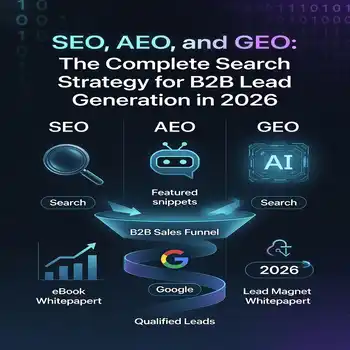
Today’s search landscape has three distinct layers — SEO, AEO, and GEO — and each one requires a different approach. Businesses that master all three own their market in search. Businesses that only do traditional SEO are losing ground to competitors who understand where search is actually going. Let’s see B2B Lead Generation strategies.
This post breaks down all three, the keywords that drive each, and exactly how to build content that ranks, gets cited by AI, and dominates local search. It connects to the full lead generation system at The Complete B2B Lead Generation System for SMBs in 2026 — because organic search is only valuable when it feeds a funnel that converts.
SEO — Traditional Search Engine Optimization
SEO is the foundation. It’s the practice of making your content rank on Google and other search engines for keywords your prospects are actively searching. Done right, it drives consistent, compounding organic traffic that doesn’t disappear when you stop paying for it.
But SEO in 2026 is not SEO in 2020. Google’s algorithm has evolved to prioritize demonstrated expertise, authoritative content structure, and user intent alignment over keyword density and backlink volume. The tactics that worked five years ago are now either neutral or actively harmful.
3 Primary SEO Keywords for Lead Generation Authority
Primary keyword: “b2b lead generation strategies” — High volume, high competition, worth fighting for. This is the keyword your ideal client searches when they’re in research mode — evaluating agencies, tactics, and approaches. Ranking here puts you in front of buyers before they’ve made any decisions.
Secondary keyword: “seo for lead generation” — Directly maps to what Innovex does. Prospects searching this are specifically evaluating SEO as a lead gen channel — they’re already qualified, already budget-aware, and already looking for someone to execute.
Supporting keyword: “organic lead generation for small business” — Long-tail with high buyer intent. The phrase “small business” self-selects your ICP. This keyword cluster produces lower volume but significantly higher conversion rates than broad SEO terms.
What SEO Requires in 2026
Topical authority over keyword stuffing. Google’s Helpful Content system evaluates whether your site demonstrates genuine expertise on a topic — not just whether specific keywords appear. A content cluster of 10 interconnected posts on B2B lead generation signals more authority than 10 isolated posts each targeting a different topic.
E-E-A-T signals. Experience, Expertise, Authoritativeness, Trustworthiness — Google’s quality evaluator framework. For a B2B service business, this means author bios with credentials, case studies with real results, About pages that establish who you are and what you’ve done, and external mentions and links from authoritative sources in your industry.
Technical foundation. Core Web Vitals, mobile performance, crawlability, structured data. These are table stakes — they don’t win rankings on their own, but their absence actively suppresses content that deserves to rank. Run a technical audit before you invest in content.
Search intent alignment. Every piece of content must match the intent behind its target keyword. Informational keywords get comprehensive guides. Commercial keywords get comparison posts and case studies. Transactional keywords get service pages with clear CTAs. Misaligning content type with search intent is one of the fastest ways to tank your rankings.
AEO — Answer Engine Optimization
AEO is the discipline of optimizing content to be cited, quoted, or summarized by AI-powered answer engines — Google’s AI Overviews, ChatGPT, Perplexity, Claude, and every other system that synthesizes answers from the web instead of returning a list of links.
This is the fastest-growing shift in search behavior. A significant and growing percentage of B2B buyers now ask AI tools for recommendations, comparisons, and how-to guidance before they ever visit a website. If your content isn’t structured to be cited by these systems, you’re invisible to a growing portion of your market.
3 Primary AEO Keywords
Primary keyword: “answer engine optimization” — The term itself is being searched by forward-thinking marketers and agency decision-makers. Ranking for it and being cited by AI for it signals that Innovex is ahead of the curve — which is exactly the positioning you want.
Secondary keyword: “how to get cited by ai search” — Direct buyer intent. This is what your prospects are searching when they realize AEO matters and don’t know where to start. First-mover advantage on this keyword cluster is significant — it’s not yet saturated.
Supporting keyword: “ai overview optimization for small business” — Specific to Google’s AI Overview feature. Small businesses searching this are actively trying to appear in AI-generated search results — they’re marketing-aware and decision-ready.
What AEO Requires
Direct, authoritative answers. AI systems scan content for clear, factual answers to specific questions. Content that buries its answer in three paragraphs of context gets passed over. Content that leads with a crisp, direct answer and then provides supporting depth gets cited. Structure every section to answer the question in the first sentence.
FAQ and Q&A structure. AI systems are trained to find answers to questions. Content structured as explicit questions followed by direct answers is significantly more likely to be cited than prose-only content. Add a dedicated FAQ section to every pillar post — written in the exact language your prospects use when talking to AI tools.
Schema markup. FAQ schema, HowTo schema, and Article schema make your content’s structure machine-readable. When an AI system is deciding what to cite, structured data is a signal that your content is organized, authoritative, and reliable.
Consistent brand entity signals. AI systems build an understanding of entities — brands, people, concepts — from across the web. The more consistently your brand appears in authoritative contexts (your site, guest posts, mentions, directories, social profiles), the more likely AI systems are to recognize Innovex Ventures as an authoritative source on B2B lead generation and digital marketing.
Comprehensive topic coverage. AI tools prefer to cite sources that cover a topic completely rather than partially. A post that covers B2B lead generation funnels from awareness to close is more likely to be cited than a post that covers only one stage. Depth and completeness signal authority.
The AEO Audit: Is Your Content AI-Ready?
Run this check on your top 10 posts:
- Does every H2 answer a specific question your prospect would ask an AI tool?
- Does the first sentence under each H2 directly answer that question?
- Is there a dedicated FAQ section at the end?
- Is FAQ schema implemented?
- Does the post cover the topic comprehensively enough to be the definitive source?
- Is your brand name mentioned in a way that signals expertise, not just services?
If the answer to any of these is no, that post is underperforming its potential in AI-powered search.
GEO — Generative Engine Optimization
GEO is the emerging discipline of optimizing content to appear in generative AI outputs — the responses produced by systems like ChatGPT, Perplexity, Google’s AI Mode, and Claude when users ask open-ended questions.
AEO and GEO overlap significantly, but the distinction matters. AEO focuses on getting cited in AI-augmented search results — the answer box, the AI Overview, the featured snippet. GEO focuses on influencing what generative AI systems say about your brand, your industry, and your competitors when users ask for recommendations, comparisons, and explanations.
When a prospect asks ChatGPT “what’s the best lead generation agency for a small B2B service business,” the answer it produces is shaped by everything that AI system has indexed about agencies in that space. GEO is the practice of making sure your brand, your content, and your positioning influence that answer.
3 Primary GEO Keywords
Primary keyword: “generative engine optimization” — Establishes Innovex as a practitioner and authority in this emerging discipline. Most agencies don’t know what GEO is yet — being one of the first to rank for it is a significant first-mover advantage.
Secondary keyword: “how to appear in chatgpt recommendations” — Direct buyer intent from business owners who’ve noticed AI tools recommending competitors and want to understand how to get included. High commercial value, low current competition.
Supporting keyword: “optimize content for ai search engines” — Broader term covering the full AEO/GEO space. Captures the research-phase prospect evaluating whether this is a discipline worth investing in. Position Innovex as the authority that can answer that question and then execute the strategy.
What GEO Requires
Being cited everywhere your brand should be mentioned. AI systems synthesize information from across the web. If your brand appears in industry publications, podcast transcripts, conference content, guest posts, and authoritative directories — all saying consistent things about what you do and who you serve — that consistency becomes the signal that shapes how AI describes you.
Owning your entity across platforms. Consistent NAP (Name, Address, Phone) data, a complete Google Business Profile, active and consistent social profiles, Wikipedia or Wikidata presence for established brands, and mentions in authoritative industry sources. AI systems triangulate entity data across sources — inconsistency creates noise that reduces citation likelihood.
Publishing content that directly answers the questions AI users ask. “What is the best lead generation strategy for a B2B service business?” — if your content answers this question better than anyone else, and it’s accessible to AI indexing systems, your content shapes the answer. Write for the question, not the keyword.
Statistical and factual content. AI systems favor citing specific data points — statistics, benchmarks, research findings — over general claims. Content that includes proprietary data, specific conversion benchmarks, case study numbers, or original research is significantly more likely to be cited than content making general claims without evidence.
SEO vs AEO vs GEO: How They Work Together
| Dimension | SEO | AEO | GEO |
|---|---|---|---|
| Primary goal | Rank in search results | Get cited in AI answer boxes | Influence generative AI outputs |
| Key signal | Backlinks + relevance | Direct answers + schema | Entity consistency + citations |
| Time to results | 3–6 months | 1–3 months | 6–12 months |
| Traffic type | Click-through visits | Featured placements | Brand mentions in AI responses |
| 2026 importance | High | Very High | Growing rapidly |
These three disciplines are not competing strategies. They’re layers of the same system. Content built for SEO provides the foundation. AEO optimization makes that content machine-readable and citation-ready. GEO work amplifies your brand’s presence across the sources AI systems draw from.
Build all three simultaneously. Every piece of content you publish should be optimized for traditional search rankings, structured for AI citation, and connected to a broader entity-building strategy.
The Content Framework: Building for All Three Simultaneously
Every pillar post and cluster post on innovexventuresllc.com should be built with this checklist:
SEO Layer
- Primary keyword in title, H1, first 100 words, and meta description
- Secondary keyword in at least one H2
- Internal links to pillar post and related cluster posts
- External link to one authoritative source
- Minimum 1,500 words — comprehensive coverage signals topical authority
- Rank Math green light before publish
AEO Layer
- Every H2 framed as a question your prospect would ask an AI tool
- First sentence under each H2 is a direct, self-contained answer
- FAQ section at the end — 5 to 8 questions in the exact language prospects use
- FAQ schema implemented via Rank Math
- No jargon in answers — write for clarity, not to impress
GEO Layer
- At least one original data point, benchmark, or case study result per post
- Brand name and positioning stated clearly — “Innovex Ventures builds B2B lead generation systems for SMBs”
- Content published under a named author with credentials
- Post promoted through channels that generate external citations — LinkedIn, industry communities, guest post references
Frequently Asked Questions
What is the difference between SEO and AEO?
SEO optimizes content to rank in traditional search engine results pages. AEO optimizes content to be cited or quoted by AI-powered answer engines like Google AI Overviews, ChatGPT, and Perplexity. SEO drives click-through traffic. AEO drives visibility in zero-click AI-generated answers.
What is GEO in digital marketing?
GEO stands for Generative Engine Optimization. It is the practice of structuring content and brand presence to influence what generative AI systems say about your brand when users ask open-ended questions. It focuses on entity consistency, authoritative citations, and data-rich content that AI systems prefer to reference.
How long does SEO take to generate leads?
For a new site targeting competitive B2B keywords, SEO typically produces meaningful organic traffic in 3 to 6 months with consistent content publishing and technical optimization. Long-tail keyword content can rank faster — sometimes within 4 to 8 weeks — and often converts at higher rates than broad competitive terms.
Should a small business invest in AEO or traditional SEO first?
Both simultaneously. The content structure that makes posts rank well in traditional search — clear answers, comprehensive coverage, proper schema markup — is the same structure that gets content cited by AI systems. Building for SEO and AEO at the same time costs nothing extra and produces significantly better results than optimizing for either in isolation.
Search Visibility Is a Lead Generation Asset
SEO, AEO, and GEO are not marketing channels in isolation. They are the top of your lead generation funnel — the infrastructure that puts your brand in front of prospects at the exact moment they’re looking for what you offer.
Visibility without conversion is wasted. Build the search presence and connect it to a funnel that captures, nurtures, and closes. For the complete framework, read The Complete B2B Lead Generation System for SMBs in 2026.
Ready to Dominate Search and Fill Your Pipeline?
Innovex Ventures builds SEO, AEO, and GEO strategies for B2B service businesses that need to own their market in search — traditional and AI-powered.
Get Your Free Strategy Session — we’ll audit your current search visibility and show you exactly what it takes to rank, get cited, and convert.
B2B Lead Generation strategies
Social Media: F->